 Skip to content
Plush toy choking hazard prevention is essential for ensuring child safety, helping manufacturers reduce risks through secure design, quality materials, and rigorous testing. Choking hazards remain one of the most critical safety concerns in the plush toy industry. Every year, small detachable components — button eyes, plastic noses, sewn-on ribbons, and under-sized stuffed parts — send thousands of children to emergency departments worldwide. For brands, importers, and contract manufacturers, understanding choking hazard prevention is not only a compliance requirement but a core pillar of responsible product development.
This guide covers the full arc of choking hazard risk management: from age-graded design rules and small-parts testing to material specifications, supply chain quality controls, and labeling requirements for the US, EU, and international markets.
Understanding Choking Hazards in Plush Toys
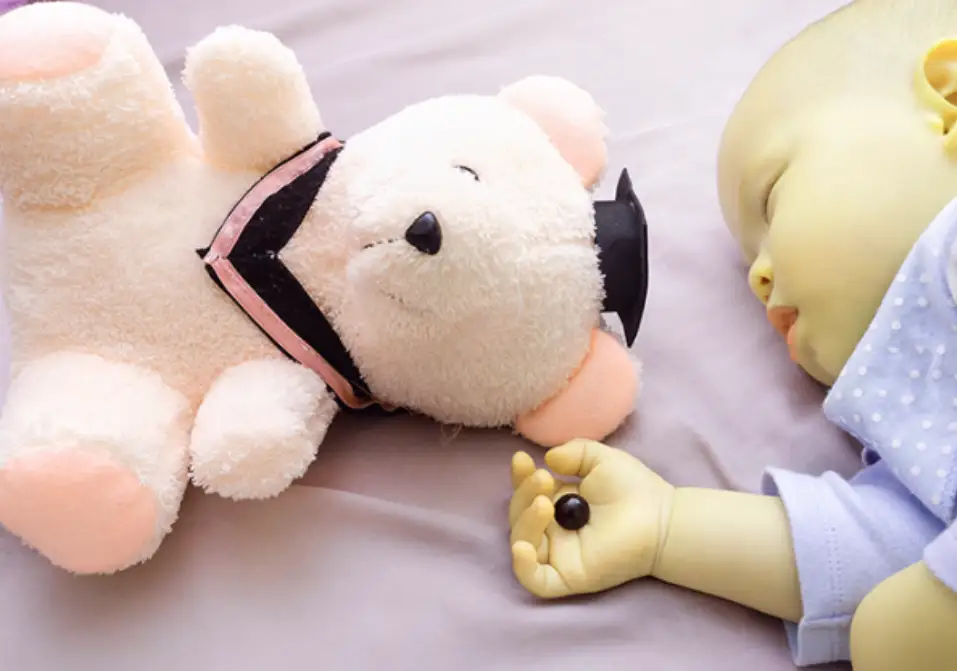
A choking hazard is any object or detachable component that, when separated from a toy, presents an aspiration or ingestion risk to children under a defined age threshold — typically 36 months (3 years) in most regulatory frameworks. In plush toys, these hazards rarely originate from the fabric body itself but almost always from embellishments: sewn-on accessories, plastic safety eyes, button closures, decorative beads, squeakers, rattle inserts, and sewn-in wire structures.
The anatomy of a choking incident in plush toys follows a predictable pattern: a component is inadequately secured during manufacturing, normal play causes progressive stress on the attachment point, and eventually the component detaches and enters a child’s airway. Preventing this outcome requires intervention at every stage — design, material selection, manufacturing process, and in-line quality control.
Age Grading and the Small Parts Cylinder Test
Regulatory standards in all major markets use a small parts cylinder as the primary mechanical gauge for age grading. Any detachable component that fits entirely within the cylinder is classified as a small part and must not be present in toys intended for children under 36 months.
| Standard | Market | Cylinder Inner Diameter | Cylinder Depth | Age Threshold |
|---|---|---|---|---|
| ASTM F963 | United States | 31.7 mm (1.25 in) | 57.1 mm (2.25 in) | Under 36 months |
| EN 71-1 | European Union | 31.7 mm | 57.1 mm | Under 36 months |
| ISO 8124-1 | International baseline | 31.7 mm | 57.1 mm | Under 36 months |
| GB 6675-2 | China (CCC) | 31.7 mm | 57.1 mm | Under 36 months |
| AS/NZS 8124 | Australia / NZ | 31.7 mm | 57.1 mm | Under 36 months |
All major standards have converged on the same cylinder geometry, which simplifies compliance testing for manufacturers serving multiple export markets. The critical takeaway: if your plush toy targets children under 3 years, every component — including embroidery thread tails, hang tags, and cord stoppers — must be verified against this gauge.
High-Risk Components and How to Engineer Them Out
Experienced product developers approach choking hazard prevention by identifying and eliminating risk at the design specification stage, rather than relying solely on post-production testing. The following components account for the majority of plush toy recall events linked to choking risks.
Button Eyes and Plastic Safety Eyes
Safety eyes with metal washers are a common embellishment on stuffed animals and plush figures. When improperly installed or subjected to high tensile pull forces, the washer can deform and release the eye shaft. For toys intended for under-36-month markets, embroidered eyes are the preferred alternative, as they eliminate the detachable component entirely. Where plastic eyes are used in age-graded products (3+), pull-force testing per EN 71-1 Section 8.4 or ASTM F963 Section 4.14 should be conducted on each production run.
Sewn-On Accessories and Decorative Elements
Buttons, beads, sequins, bows, and ribbon attachments are frequently cited in CPSC recall notices. These components should be stress-tested using the torque and pull-force procedures specified in applicable standards. For infant and toddler plush, the safest approach is to avoid all sewn-on hard accessories and replace them with printed or embroidered equivalents.
| Component Type | Test Method | Minimum Pull Force (0–18 months) | Minimum Pull Force (18–36 months) |
|---|---|---|---|
| Plastic eyes/noses | EN 71-1 Clause 8.4 / ASTM F963 §4.14 | 90 N for 10 sec | 70 N for 10 sec |
| Sewn-on buttons | EN 71-1 Clause 8.4 | 90 N for 10 sec | 70 N for 10 sec |
| Ribbons and bows | EN 71-1 Clause 8.5 (torque) | 0.34 N·m for 10 sec | 0.34 N·m for 10 sec |
| Squeaker/rattle inserts | ASTM F963 §4.14.3 (abuse test) | Must not release after abuse | Must not release after abuse |
| Hang tags/cord loops | EN 71-1 / ASTM abuse sequence | Remove before sale or secure | Remove before sale or secure |
Stuffing Materials and Internal Component Safety
While external embellishments are the most visible choking risk, internal components present an equally serious hazard if a plush toy’s seam integrity fails. Rattle pellets, squeaker mechanisms, weighted beads, wire armature segments, and sound modules can all become choking hazards if accessible after seam failure.
Seam Strength and Bite Testing
Seam integrity is evaluated through both pull-force testing and bite simulation (abuse testing). Under EN 71-1 and ASTM F963, toys for children under 36 months must be subjected to a drop test, bite test, and mechanical abuse sequence. Any component that becomes accessible through seam failure during these tests must either be secured, enlarged beyond small-parts dimensions, or removed from the design.
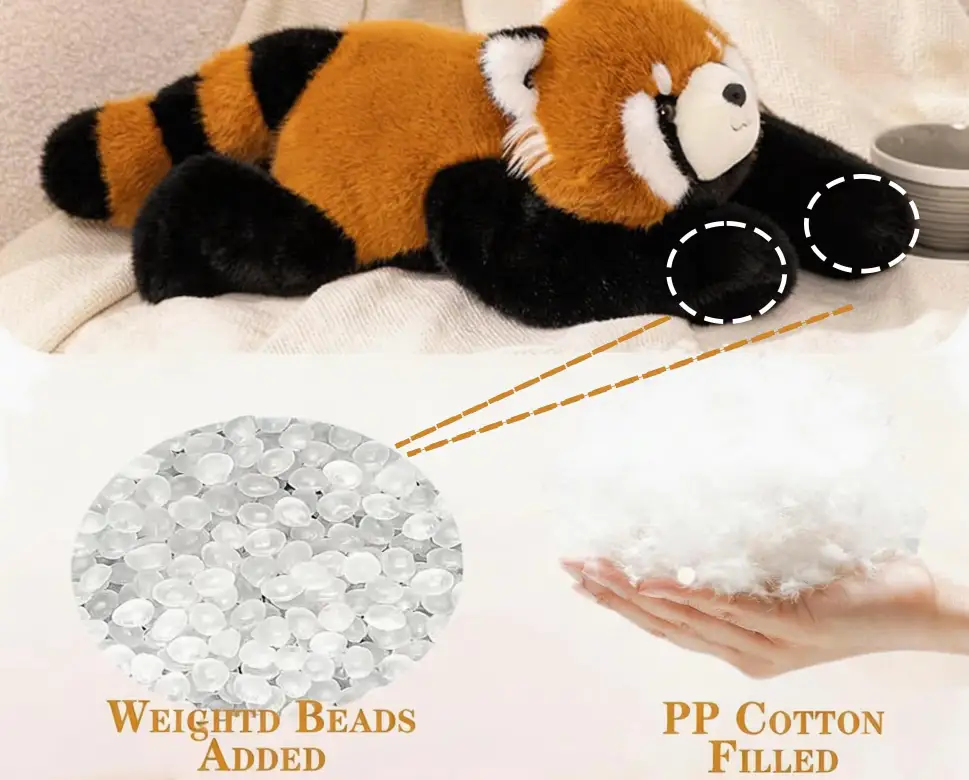
Pellet Fill and Weighted Plush
PP cotton remains the standard fill for safe plush toys in infant categories. Designs incorporating plastic pellets, glass beads, or micro-granule fills for weighted or sensory applications require additional seam construction precautions — typically double-stitched and bar-tacked inner pouches — and must be clearly age-graded 3+ or higher. The pellet pouch must survive abuse testing without releasing fill material.
| Internal Component | Risk Level (Under 36 mo) | Mitigation Approach | Standard Reference |
|---|---|---|---|
| PP cotton (virgin fiber) | Low | Standard seam construction | EN 71-1 / ASTM F963 |
| Plastic rattle pellets | High | Double-sewn inner pouch + abuse test | ASTM F963 §4.14.3 |
| Squeaker mechanism | Medium-High | Encased in inner fabric pouch, seam-tested | EN 71-1 §8.4 |
| Electronic sound module | High | Secure compartment, tamper-evident stitching | EN 62115 (electrical toys) |
| Wire armature | Very High | Age-grade 3+ minimum; full coverage fabric | EN 71-1 §4.13 |
Labeling Requirements and Age-Grade Communication
Correct labeling is a legal requirement and a frontline consumer safety tool. Regulatory authorities in the US, EU, UK, and Australia all mandate specific warning language for toys presenting small-parts or choking hazard risks. Failure to label correctly constitutes a product defect independent of the physical safety performance of the toy itself.
US ASTM F963 and CPSC Labeling
Toys with small parts that are intended for children between 3 and 6 years must carry the warning: “CHOKING HAZARD — Small parts. Not for children under 3 yrs.” This language must appear on the principal display panel of the packaging and, where practical, on the product itself. The CPSC’s Labeling Requirements for Art Materials and Toys regulation (16 CFR Part 1500.19) sets minimum type size and placement rules.
EU EN 71 CE Mark and Warning Symbols
Under EN 71-1 and the EU Toy Safety Directive 2009/48/EC, toys containing small parts for children aged 0–36 months must carry a “Not suitable for children under 36 months” warning accompanied by the standardized pictogram (crying child face with age indication). This warning must appear on both the toy and its packaging in the language of each member state in which it is sold.
| Market | Applicable Regulation | Mandatory Warning Text | Pictogram Required |
|---|---|---|---|
| United States | ASTM F963 / 16 CFR 1500.19 | “CHOKING HAZARD — Small parts. Not for children under 3 yrs.” | No (text mandatory) |
| European Union | EN 71-1 / Directive 2009/48/EC | “Not suitable for children under 36 months” + national language | Yes (ISO pictogram) |
| United Kingdom | UK Toy Safety Regulations 2011 | Same as EU EN 71 post-Brexit alignment | Yes |
| Australia / NZ | AS/NZS 8124-1 / ACCC | “WARNING: Choking hazard — contains small parts.” | Recommended |
| Canada | Canada Consumer Product Safety Act / SOR/2011-17 | “AVERTISSEMENT / WARNING — Small parts. Not for children under 3 yrs.” | No |
Quality Control Integration Across the Production Process
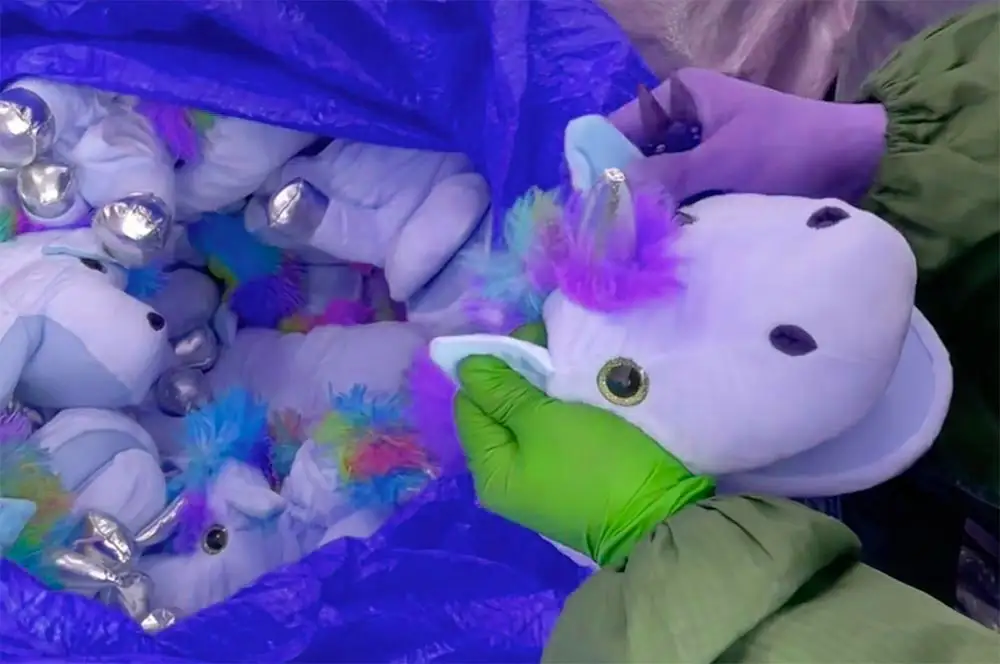
Choking hazard prevention cannot be treated as a final inspection checkpoint alone. Manufacturers serving safety-conscious buyers integrate risk controls across the full production workflow — from material receiving through IPQC (in-process quality control) and final outgoing inspection.
Pre-Production Design Review
Every new plush toy SKU destined for markets with children under 36 months should undergo a formal DFM (design for manufacturability) review that includes a small-parts checklist. This review evaluates every component against the small parts cylinder, checks pull-force margins against relevant standards, and flags any decorative elements that require design modification before a production sample is cut.
In-Process Quality Control Checkpoints
IPQC operators on the production line should perform random pull-force checks on safety eyes, sewn accessories, and seam junctions at a defined frequency — typically every 200–500 units depending on production volume and historical defect rates. Pull-force gauges calibrated to standard specifications must be available at each sewing station handling attachment components.
Final Pre-Shipment Inspection
Third-party pre-shipment inspection (PSI) by accredited labs covers random sampling per AQL (Acceptable Quality Limit) standards. The inspection report should include documented pull-force test results, small-parts cylinder assessment for all detachable components, and visual seam integrity checks. A golden sample retained from the approved prototype serves as the reference point for all production comparisons.
| Production Stage | Control Action | Responsible Party | Documentation |
|---|---|---|---|
| Material receiving | Verify component sizes vs. small-parts gauge | QC incoming inspector | Material receiving log |
| Pre-production sample | Full pull-force + bite + drop abuse test | Third-party lab | Lab test report |
| In-process (every 200–500 pcs) | Random pull-force check, seam inspection | IPQC operator | IPQC worksheet |
| Bulk production (mid-run) | DuPont sampling check vs. golden sample | Factory QC supervisor | Mid-production report |
| Pre-shipment | AQL inspection + final small-parts assessment | Third-party inspector (SGS/Intertek/BV) | PSI report |
Frequently Asked Questions
A small part is defined as any object — or detachable component of an object — that fits entirely within the standardized small parts cylinder used by ASTM F963, EN 71-1, ISO 8124-1, and equivalent standards. The cylinder has an inner diameter of 31.7 mm and a depth of 57.1 mm. If a component fits completely inside this cylinder when tested in any orientation, it is classified as a small part and must not be present in toys intended for children under 36 months. This definition applies both to original components and to any component that could reasonably detach during normal use or foreseeable abuse.
Yes, embroidered eyes are significantly safer for toys intended for children under 36 months because they eliminate the detachable component entirely. Plastic safety eyes, even when properly installed with a locking washer, can be subject to pull-force failure if the washer deforms under stress or if the installation was inconsistent during production.
Embroidered features are integrated into the fabric substrate and present no detachable element. Most major toy brands specify embroidered or heat-transfer printed facial features as the default for all infant and toddler (0–36 months) plush toys. For age-graded 3+ products, plastic safety eyes are permissible provided they pass documented pull-force testing per EN 71-1 or ASTM F963.
Industry best practice calls for pull-force testing at three distinct stages. First, during the pre-production approval phase, a full third-party lab test (covering pull, torque, bite, and drop abuse procedures) should be completed on the initial production sample and any revised sample after design changes.
Second, during in-process quality control, factory operators should perform pull-force checks using calibrated gauges at a frequency of approximately every 200 to 500 units produced, depending on production volume and the criticality of the components involved. Third, at the pre-shipment inspection stage, the third-party inspector should independently verify pull-force performance on randomly selected units from the production run. Documentation of all three stages should be retained and available to buyers and regulatory authorities on request.
Products sold across both markets must meet the stricter of the two labeling requirements on each specific point, which in practice means carrying both the ASTM F963/CPSC required English-language warning text (“CHOKING HAZARD — Small parts. Not for children under 3 yrs.”) and the EU-compliant warning with the standardized ISO pictogram (the crying child silhouette with age indication) along with the appropriate translated text for each EU member state market.
The CE mark indicating conformity with EN 71 must appear on both the toy and packaging. For US import, the CPC (Children’s Product Certificate) citing the applicable CPSC regulations and test reports must be prepared and retained by the importer of record. Dual-market compliance requires coordination between your packaging design team and your compliance consultant before artwork is finalized.
Weighted plush toys filled with plastic pellets, glass micro-beads, or similar granular materials present a significant choking hazard if the outer seams or inner pouch fails, and are generally not recommended for children under 36 months. While it is technically possible to design a pellet-filled plush toy for this age range — using double-stitched inner pouches, bar-tack reinforcement, and seam-strength testing that exceeds standard requirements — the product must survive the full abuse test sequence (drop, bite, mechanical abuse) without releasing any fill material, and every released pellet must pass the small-parts cylinder test. In practice, most brands age-grade weighted plush toys at 3 years and above to minimize liability exposure. Sensory plush toys for infants that require weight or texture effects typically use dense PP cotton or fabric textures rather than pellet fill as the safer design alternative.